Literature · Scientific foundation ·
The scientificfoundation of dimetriq.
dimetriq is based on the Hierarchical Taxonomy of Psychopathology (HiTOP) – an empirically derived, dimensional model of psychological burdens that complements and surpasses traditional categorical systems such as DSM-5 and ICD-11.
The Hierarchical Taxonomy of Psychopathology (HiTOP) organises psychological burdens in an empirically derived, dimensional hierarchy – from the overarching p-factor through spectra and subfactors to individual symptoms.
Hierarchical levels
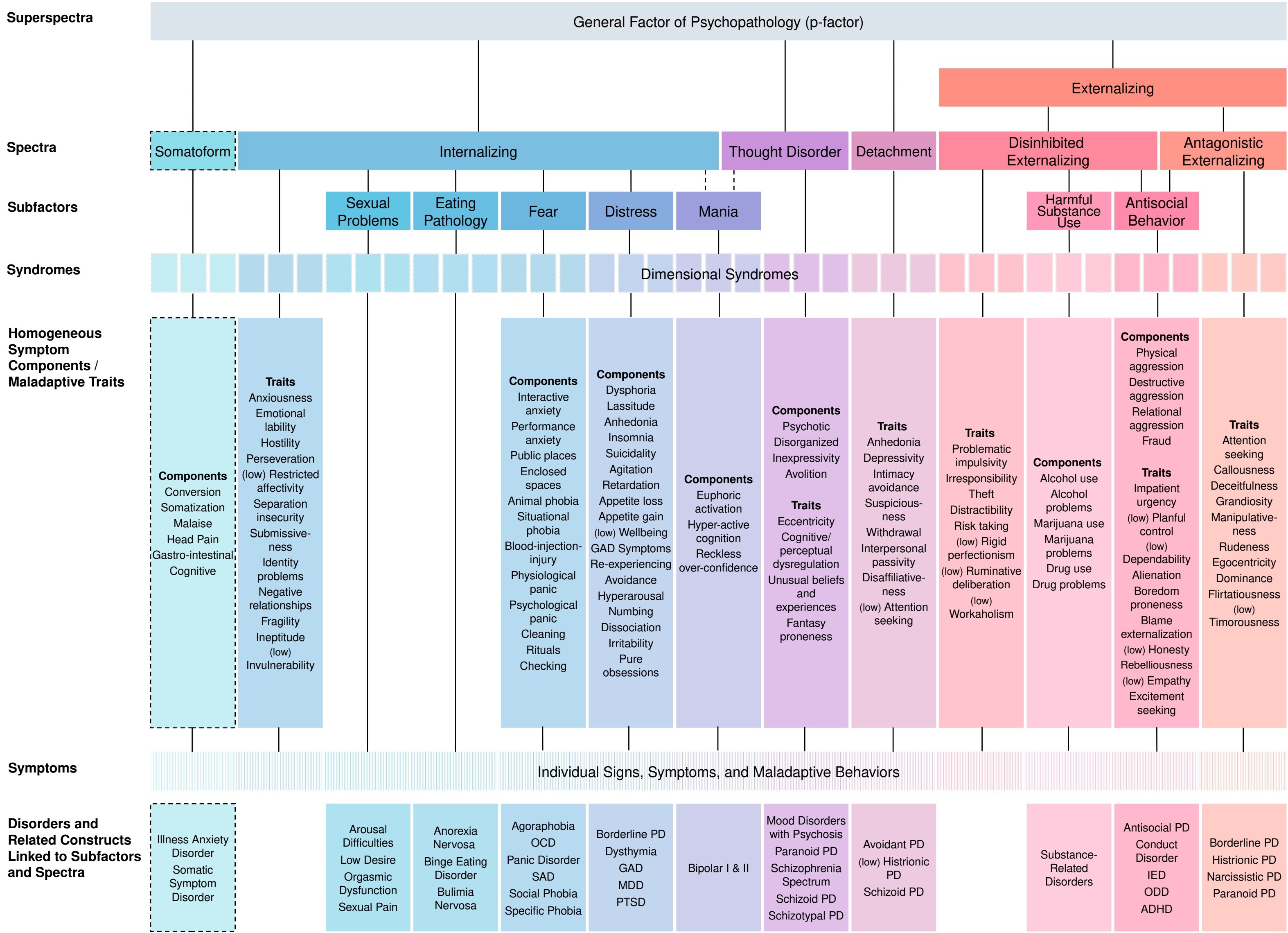
Right-click the image above to download a copy, or click here to download an editable PowerPoint file. Published under CC BY 4.0 on OSF: osf.io/rscqf
Advantages vs. DSM-5 / ICD-11
Methodological
- ▸Higher reliability through dimensional measurement
- ▸Reduction of artificial comorbidity
- ▸Empirically grounded structure instead of expert consensus
- ▸Capture of subclinical burdens
- ▸Compatible with transdiagnostic therapy approaches
Clinical implications
Practical
- ▸Individual burden profiles instead of binary diagnoses
- ▸More sensitive progress measurement across sessions
- ▸Better treatment planning through spectra profiles
- ▸More differentiated communication with patients
- ▸Integration into existing documentation systems
Sources
Studies
Kotov, R., Krueger, R. F., Watson, D., et al. (2017)
The Hierarchical Taxonomy of Psychopathology (HiTOP): A dimensional alternative to traditional nosologies.
Journal of Abnormal Psychology, 126(4), 454–477 · DOI: 10.1037/abn0000258
Ruggero, C. J., Kotov, R., Hopwood, C. J., et al. (2019)
Integrating the Hierarchical Taxonomy of Psychopathology (HiTOP) into clinical practice.
Journal of Consulting and Clinical Psychology, 87(12), 1069–1084 · DOI: 10.1037/ccp0000452
Conway, C. C., Forbes, M. K., Forbush, K. T., et al. (2019)
A hierarchical taxonomy of psychopathology can transform mental health research.
Perspectives on Psychological Science, 14(3), 419–436 · DOI: 10.1177/1745691618810696
Frequently asked
Frequently asked from research
Methodological, ethical and collaboration-related questions around dimensional diagnostics with dimetriq.
Interested in research collaboration?
We welcome exchange with researchers, students and everyone interested in dimensional psychodiagnostics.
Cookies & local storage
We only use technically necessary cookies or local storage to run this website. There is no tracking or analytics. For a full overview, open "Settings".